Wujiang Road Shengjian
吴江路生煎 · Wújiānglù Shēngjiān
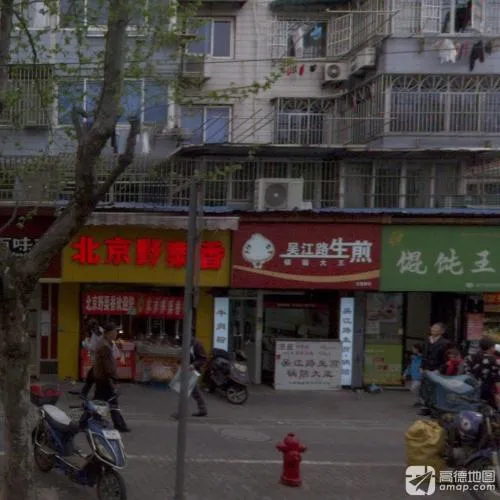
Chain at a glance
- Category
- Buns & Dumplings
- Branches in Shanghai
- ~40
- Typical spend
- ¥12–20 per person
- Payment
- Cash / Alipay / WeChat
- English menu
- Point to order
Show this to order
一两生煎,一碗牛肉粉丝汤
yi liang sheng jian, yi wan niu rou fen si tang · One liang of shengjian and a beef-vermicelli soup
Wujiang Road is the snack street that made shengjian famous — the lane off Nanjing West Road where the original pan-fried-bun legends cooked through the 1990s, drawing queues that became one of the defining images of Shanghai street food. That lane has been rebuilt and its famous tenants have moved on or become chains, but the name still sells, and this chain — 40-odd branches scattered through residential Shanghai — trades on exactly that memory: no-frills shengjian and guotie, fried in black pans, sold cheap from early morning.
To be clear about lineage: the historically famous stalls on Wujiang Road itself were other businesses, and the biggest one grew into Yang’s Fry-Dumpling, covered separately in this guide. This chain borrows the street’s name the way a thousand restaurants borrow “Nanjing” for duck blood soup. The relevant questions are not about lineage but about the plate: are the buns fresh, is the base crisp, is the price honest. At the good branches, on a good hour, the answers are yes.
What it is, and isn’t
These are the budget continuation of the style: small shengjian with thin skins and a modest amount of soup, more crisp than fluffy, priced so that a plate and a bowl of beef-vermicelli soup costs about ¥15. The style leans toward the thin-skinned old-school camp of the shengjian guide rather than Yang’s fluffy school — less bread, more fried surface, a bun you eat four of instead of two.
At this price the ceiling is low and the floor is high: the chain is consistent, the pans turn over quickly, and a fresh batch at a busy branch beats a slow batch at a famous shop. The failure mode is the same as every shengjian operation — a batch that sits — and the defense is the same: order from the pan in front of you, and if it looks tired, order the guotie instead, since many branches fry both and the pans take turns being fresh.
The early-bird rule
These are morning shops in morning neighborhoods. Branches open at 5 or 6 a.m.; by 8:30 the pans are at their busiest and best; by mid-afternoon some branches have sold down to scraps. The Xincun Road shop in Putuo even closes for the afternoon lull and reopens at 4:30 — a working neighborhood’s rhythm kept honestly. The Zhongshan North Road branch (near Xizang North Road station, north Jing’an) is the most central, and its morning room — schoolkids, e-bike commuters, a queue that dissolves every eight minutes when a pan lands — is as authentic a Shanghai scene as anything in this guide.
The order
By the liang, like all pan-fried dumplings: one liang of shengjian (about five small buns) plus the beef-vermicelli soup (牛肉粉丝汤) — clear broth, glass noodles, a few beef slices — is the complete breakfast and the order phrase at the top of this page. Undecided between shengjian and guotie? Some branches will do a mixed liang (拼一份); point at both pans and see. Payment is QR code or cash, and the counters move fast.
Why include a budget chain?
Because the price tier is where the dish actually lives. Shanghai eats far more ¥12 shengjian than ¥30 shengjian, and a visitor who only eats the famous houses gets a distorted picture of both the food and the city. The honest hierarchy: Yang’s for the famous fluffy version, the destination houses in the shengjian guide for the craft version, and this tier for the daily plate — eaten standing, from a paper sleeve, with the soup in the other hand.
A working-neighborhood morning
The Xincun Road branch in Putuo offers the most complete version of what this chain is for. Arrive at 6:30, when the first rush is schoolchildren and the pans are producing at full speed. One liang of shengjian, one beef soup, eaten on a stool while the lane outside fills with e-bikes and breakfast commerce — the noodle window next door, the bun counter across, the fruit cart arriving. Then walk fifteen minutes east to Caoyang, one of the city’s oldest workers’ new-towns, built in the 1950s as a garden district for labor heroes and still lived in by their descendants. It is a morning of Shanghai as the city experiences itself, and it costs about ¥15 including the walk.
What to skip, and batch logic
Skip anything that did not come off the pan in the last few minutes — at this price, freshness is the entire product, and the counter will hold a fresh order for the next batch if you point at the pan and wait. Skip the sweet soy drinks at the chiller in favor of the soup; the combination of broth and buns is the balanced local order. The batch logic matters more here than at the famous chains: these pans are smaller, and one liang might be the tail of a batch. If the buns look pale and soft rather than blistered, they sat — order the guotie from the neighboring pan instead, which at many branches runs fresher through the morning.
Good to know
- Go before 9 a.m., or in the reopened evening window at branches that pause. The pan schedule is the menu.
- If the pan looks tired, order the guotie — or wait for the next batch, which the counter will signal by pouring the slurry.
- Cash and QR both work; have payment ready before the buns land.
- Sold by weight: 一两 for one person is right; two people order 三两 plus two soups.
- Do not expect the famous street. For the Wujiang Road experience itself — the rebuilt lane, Yang’s flagship nearby — make the walk; this chain is for the mornings after.
Practicalities
Branches open at 5 or 6 a.m. and close between 7 and 8 p.m., with the Putuo shops running the most old-fashioned schedules — the Xincun Road branch even pauses mid-afternoon. Payment is QR or cash; ordering is at the counter, by the liang, with the pans as the menu. The shops are small, the seating minimal, and the surrounding neighborhoods are the show — plan a walk, not a sit. Families manage fine in the mornings, less so at the noon squeeze. Delivery is popular at this tier, but shengjian are a five-minute food and the paper sleeve exists precisely for the door-to-mouth interval; eat them standing outside the shop, in the steam, where the base stays loud. That sentence is the whole practical advice for this chain: stand close, eat fast, burn responsibly.
The street behind the name
Wujiang Road earned its food fame the honest way: geography. A short lane running off Nanjing West Road, it sat perfectly between the office towers and the residential lanes, and in the 1990s its cheap rents and heavy foot traffic produced one of the densest snack streets in Asia — pan-fried buns, noodle counters, crab houses, open past dawn. The street was rebuilt into a tidy pedestrian mall in the 2000s, and most of the legends became chains or memories; Yang’s, covered in this guide, is the most direct descendant. This chain’s name is a tribute rather than a location — its branches sit in the residential neighborhoods where breakfast actually happens now — and eating at one with that history in mind is a small lesson in how street food survives cities: by moving into the side streets and keeping the price down.
What to order
Shengjian 生煎
Small pan-fried buns sold by the liang; come when the pan is fresh.
Guotie 锅贴
Many branches fry both; get half-and-half if undecided.
Beef-vermicelli soup 牛肉粉丝汤
The standard side that turns a snack into a ¥15 meal.
Read more about the dishes
Central branches to try
A few well-placed branches picked from the map data — the chain has many more across the city.
Common questions
What should I order at Wujiang Road Shengjian?
One liang of shengjian (生煎), the small pan-fried buns — time it to a fresh pan — plus beef-vermicelli soup (牛肉粉丝汤), the standard side that turns the snack into a roughly ¥15 meal.
Is this chain actually on Wujiang Road?
No — it borrows its name from Shanghai's most famous snack street, but the branches listed here are on Zhongshan North Road in Jing'an and on Meichuan and Xincun roads in Putuo.
How much is a plate of shengjian here?
¥12–20 per person, and the shengjian-plus-soup combo comes to about ¥15 — the budget end of the shengjian chains in this guide.
When should I visit Wujiang Road Shengjian?
The Jing'an shop runs daily 06:00–20:00 and Putuo's Meichuan Road shop 06:00–19:00. Note the Xincun Road branch closes midday — 05:00–13:00, reopening 16:30–20:30 — so mind the afternoon gap.
Which branch is nearest a metro station?
The Zhongshan North Road shop in Jing'an is the easy one — it sits by Xizang North Road station, exit 2.