Shengjian Bao: Shanghai’s Pan-Fried Pork Buns
生煎包 · shēng jiān bāo
Before you order
- Payment
- Cash / Alipay / WeChat
- English menu
- No
- Ordering
- Point to order
- Hours
- 24 hours, daily
- Seating
- A few stools
- Wait
- ~10 min
- Price
- ¥13–22 per portion4 pcs · ¥3.25–5.50 each
ORDER Four pork buns (one portion, around ¥13), Curried beef soup, if the shop makes its own
SKIP Feng Yu 丰裕 (not my first choice), Buns that have been sitting out and lost their crispness
Visited Aug 20, 2026
Metro: South Huangpi Road (Line 1, Line 14) · 5 min walk
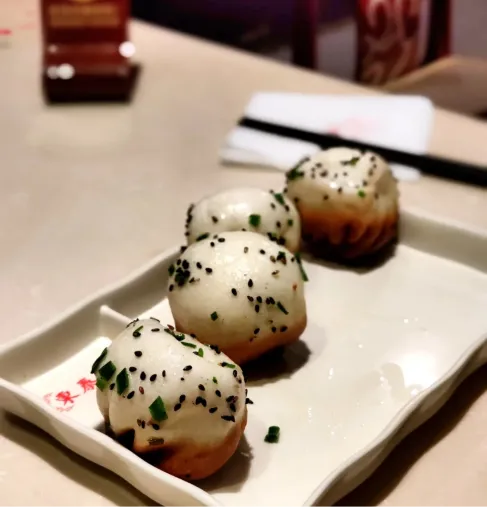
A good shengjian bao has a crisp, golden-brown bottom and a soft top, with seasoned pork tucked inside. Some are full of hot broth; others are closer to a fluffy bread bun. It’s worth knowing which kind you’re ordering.
Look for 生煎 on the sign
You’ll often see 生煎馒头 or simply 生煎 on shop signs, rather than 生煎包. In Shanghainese, 馒头 can refer to a filled bun, so those are the characters to look for when you’re walking down the street.
Three chains, three different styles
Xiaoyang 小杨生煎 makes thin-skinned buns with plenty of soup and a crisp bottom. If you like xiaolongbao, this is an easy place to start. Just give the broth time to cool before taking a big bite.
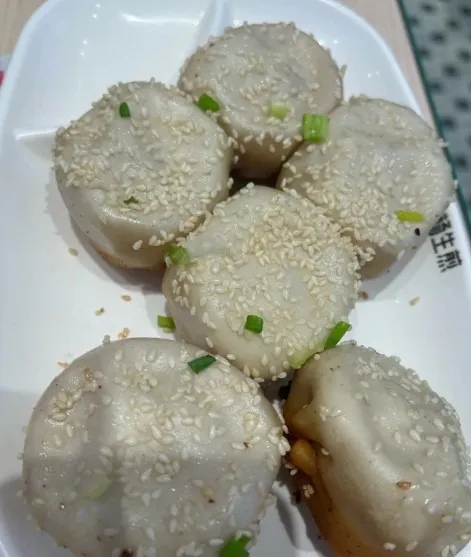
Dahuchun 大壶春 uses thicker, fluffier dough and much less soup. Fresh from the pan, the bottom is the crispest of the three. Choose it for the contrast between the crunchy base and the soft, bread-like bun, rather than for a mouthful of broth.
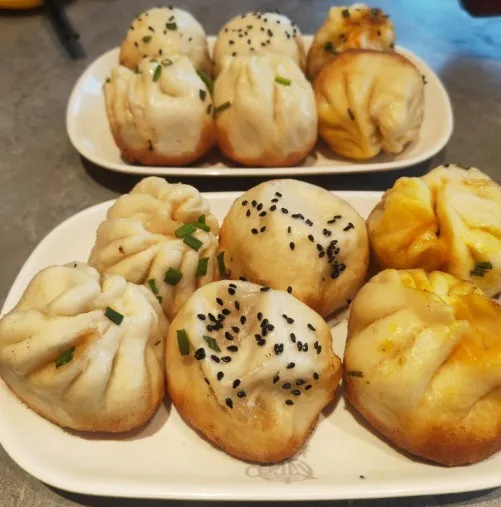
Dongtaixiang 东泰祥 is my pick. You get a crisp bottom and fluffy dough, but still some soup inside. I prefer the seasoning in the pork filling here, which is why this is the one I keep coming back to.
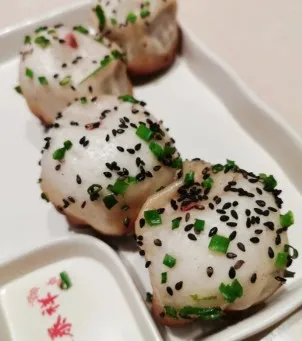
Feng Yu 丰裕 still appears on older lists, but it wouldn’t be my first choice. I’d head to one of the three above instead.
A note on ingredients
The dough contains wheat, the pork filling is seasoned with soy sauce, and sesame and scallions usually go on top. If you have an allergy, ask about ingredients and shared equipment before ordering. Removing a topping won’t necessarily make the bun safe to eat.
Before you join the line
Some branches take orders through a WeChat mini-program: you scan a QR code at the counter or table, then choose from the menu on your phone. Check how it works before joining the line, and keep some cash handy in case the app gives you trouble.
English menus vary by branch. If there isn’t one, show the staff 生煎 on your phone and confirm the portion size before paying.
How to eat one without burning your mouth
Treat a soup-filled shengjian much like a xiaolongbao. The crisp bottom can hold a surprising amount of hot broth.
- Pick it up gently with chopsticks and support it on a spoon.
- Nibble a small opening near the top of the bun.
- Let the steam escape, then tip a little broth into the spoon and check the temperature before sipping.
- Eat the rest once it has cooled enough to enjoy.
Take particular care at Xiaoyang, where there’s more soup. Dahuchun’s buns have less broth, but they’re still hot straight from the pan.
Pour a little dark vinegar into a dipping dish if you like. It cuts through the richness of the pork, especially after you’ve sipped the soup.
What to order
A portion of four pork buns is around ¥13. You can point to the pan or show the Chinese name above, then check how many buns come in a portion.
Curried beef soup makes a good side if the shop prepares its own. The quality varies: a freshly made bowl is a better bet than one mixed from a packet.
When to go
Breakfast, from 7–9 a.m., and lunch, from 11:30 a.m.–1 p.m., tend to be the busy periods. Try around 9:30–11 a.m. if you’d rather avoid the rush.
More important than the exact time is the next batch. Freshly cooked buns have crisp bottoms; buns left sitting on a tray lose that crunch. If another pan is nearly ready, I’d wait for it.
Getting there
Google MapsAmap / 高德 (works in China)
Google Maps can be unreliable in mainland China. Use Amap for directions, or show the Chinese address above to your driver.