Yang's Fry-Dumpling
小杨生煎 · Xiǎoyáng Shēngjiān
Chain at a glance
- Category
- Buns & Dumplings
- Branches in Shanghai
- ~220
- Typical spend
- ¥20–35 per person
- Payment
- Cash / Alipay / WeChat
- English menu
- Point to order
Show this to order
一份经典鲜肉生煎,一碗老鸭粉丝汤
yi fen jing dian xian rou sheng jian, yi wan lao ya fen si tang · One classic pork shengjian and a duck-vermicelli soup
Xiao Yang Shengjian is the chain most visitors end up at first, and with reason: it grew out of a stall on Huanghe Road near People’s Square in the mid-1990s and rode the shengjian boom into more than 200 branches across the city — the largest pan-fried-bun empire in Shanghai and, by most counts, the country. The original neighborhood is still the best place to eat it. The Huanghe Road shop draws a steady line of locals and tourists every day, and the lane around it — once the epicenter of the city’s snack scene — still reads like a food street even after decades of change.
For many travelers, this shop is their introduction to shengjian as a concept: a pork bun, pan-fried until the bottom turns golden, soup locked inside a raised skin. Done well it is one of Shanghai’s definitive foods. Done carelessly it scalds the roof of your mouth. This page covers how to get the good version and how to eat it without injury.
The style, honestly
Shanghai’s shengjian world splits into two camps, and Yang’s sits firmly in one of them. The fluffy school — Yang’s school — uses a yeasted, slightly bread-like skin that puffs as it fries, giving a soft top, a chewy rim, and a thick crisp base. The thin-skinned old-school camp makes a more delicate, dumpling-like bun with less dough. Neither is wrong; they are different dishes sharing a name, and locals argue about it with the passion other cities reserve for politics. If you have read our shengjian guide, you know the dividing line; Yang’s is the crowd-pleaser side of it — less delicate, more filling, and very consistent from branch to branch.
What the chain genuinely does well is the fry itself. The pans are big, the batches turn quickly, and the bottoms come out evenly browned rather than burnt or pale. At shengjian’s price point, consistency at scale is the whole craft, and this is where two decades of practice shows.
How to eat one without regret
Watch the soup. A Yang’s shengjian arrives scalding, with broth pooled inside the skin. The local technique: bite a small hole in the side, let the steam escape for a few seconds, sip the soup out, then eat the rest dipped in the black vinegar on the table. First-time eaters regularly burn a mouth roof by biting straight in, and the staff will not think less of you for poking a hole with a chopstick first — it is a recognized survival technique.
The vinegar is not optional decoration. Shanghai’s black vinegar cuts the richness of the fried skin and the pork, and most regulars add a few shreds of pickled ginger where it is offered. Eat the buns while the base is still crisp — a shengjian that sits for ten minutes is a different, sadder food.
The menu, decoded
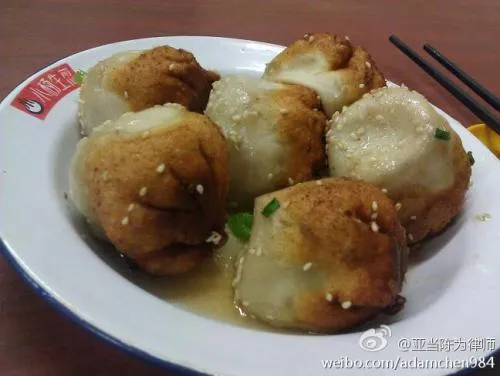
The classic order is a plate of four to six pork shengjian (经典鲜肉生煎), which arrives crowded on a small plate, bases shining. Around it:
- Crab-roe shengjian (蟹粉生煎). The seasonal upgrade, with crab roe mixed into the pork filling. It costs noticeably more and is only worth it during hairy-crab season, late autumn into winter, when the roe is actually fresh. Off-season, stick to pork.
- Duck-vermicelli soup (老鸭粉丝汤). The standard partner: a clear, peppery duck broth with glass noodles and duck offal. It is a Nanjing-style bowl that Shanghai adopted wholeheartedly, and it resets your palate between rich bites of shengjian.
- Fish ball soup (鱼丸汤). The lighter alternative — mild fish balls in a clear broth, and the safer pick for cautious eaters.
- Noodle soups and rice cakes round out the menu at most branches, but they are supporting cast; the pans by the door are the reason you came.
A pork plate plus a soup is a full meal and lands around ¥25–30 per person.
Working a branch
Street branches work like this: join the queue, order at the counter, take a number, and collect when it is called. Mall branches add kiosks with photos, air-conditioning, and, critically, toilets. The buns are the same. Payment is QR code first, cash accepted.
The Ningbo Road flagship, a five-minute walk from Nanjing Road East station, runs 24 hours and rates around 4.4 on Google from nearly 400 reviews — the strongest review base of any shengjian shop in the city center. The Huanghe Road original keeps a steadier stream of regulars and more atmosphere: an old snack lane, steam rolling out the door, the occasional tour group photographing the pan. Both are correct answers.
The Huanghe Road circuit
For the full 1990s-snack-street experience, run this loop on a first morning. Start at Da Wang’s guotie counter at the top of Huanghe Road (see Da Wang in this guide) around 8 — one liang and the beef soup — then walk two blocks south to Yang’s flagship at No. 97 for the shengjian course: one plate of classics, vinegar, the queue’s local rhythm. Two pan-fried courses in forty minutes might sound excessive; this is the street’s entire heritage, and portions are small by design. Finish south through People’s Square to the museum, or east along Ningbo Road, where the 24-hour branch covers anyone who skipped breakfast entirely. Either way, you will have eaten the lane that made the dish famous, in the order the city eats it, for under ¥50 for two.
Menu notes and what to skip
The classics hold the board: pork shengjian, the crab version in season, the duck soup and its fish-ball alternative. Skip the rice-noodle and fried-rice entries that pad larger menus — they are mall-court reflexes, not the pans’ work. The one decision worth slowing down for is crab season: from late autumn the crab-roe version (蟹粉生煎) appears at roughly double the pork price, and the honest guidance is to order it only in the months when hairy crab is actually in the markets — the roe is fresh, the premium is fair, and the shop sells out by afternoon. Off-season, the same money buys two pork plates, which is the better trade. For spice-adjacent curiosity, the mala shengjian some branches run is a chain-era invention; entertaining once, heretical twice — order it as a third course, not a replacement.
Good to know
- The chain is everywhere. If the queue at one branch is absurd, another is usually within ten minutes’ walk; check the map links in the branch list above.
- In autumn and winter, look for the crab-roe version — and expect it to sell out by afternoon at busy branches.
- Black vinegar on every table. Use it.
- Mall branches for comfort, street branches for atmosphere. The Huanghe Road and Ningbo Road pair covers both within one walk of People’s Square.
- Most branches also sell xiaolongbao — a reasonable second course if you are comparing the city’s dumplings. Our xiaolongbao guide covers where else to take that comparison.
A last word on queues
A queue at a shengjian shop is not a cost, it is a timer: it means a pan is finishing and the next batch will land as you reach the counter, which is the best possible synchronization in this cuisine. The Yang’s branches with lines are, on average, serving fresher buns than the empty ones — the pan turnover is the quality mechanism, and turnover is what lines produce. Join it. The twenty minutes you spend behind a dozen locals is the most reliable quality signal in the entire category, and the buns at the end of it arrive at the exact minute the kitchen hits its stride.
What to order
Classic pork shengjian 经典鲜肉生煎包
Fluffy raised skin, crisp golden base, pork filling with soup inside.
Crab-roe shengjian 蟹粉生煎包
The seasonal upgrade — richer, and worth doing in hairy-crab season.
Duck-vermicelli soup 老鸭粉丝汤
The standard partner: a clear duck broth with glass noodles.
Fish ball soup 鱼丸汤
A lighter side that offsets the richness of the fried buns.
Read more about the dishes
Central branches to try
A few well-placed branches picked from the map data — the chain has many more across the city.
小杨生煎(上海淮海巴春店)
淮海中路939-947号巴黎春天B1
Huangpu · Daily 10:00–22:00 · South Shaanxi Rd Stn
Common questions
What is the classic order at Yang's Fry-Dumpling?
A plate of classic pork shengjian (经典鲜肉生煎) — fluffy raised skin, crisp golden base, pork with soup inside — with the duck-vermicelli soup (老鸭粉丝汤). Fish ball soup (鱼丸汤) is the lighter alternative side.
When is the crab-roe shengjian worth ordering?
The crab-roe shengjian (蟹粉生煎) is the seasonal upgrade — richer, and worth doing in hairy-crab season. Off-season, stick to the classic pork plate.
Which Yang's branch is closest to People's Square?
The Huanghe Road original at No. 97, whose nearest station is People's Square. The 24-hour Ningbo Road flagship is by Nanjing Road East station exit 6, and the Huaihai Road shop sits at South Shaanxi Road station.
Is there a 24-hour Yang's branch?
Yes — the Ningbo Road flagship at 178 Ningbo Road runs around the clock, by Nanjing Road East station exit 6. Huanghe Road keeps daily 06:30–22:00 and the Huaihai Road mall branch 10:00–22:00.
How much does a meal at Yang's cost?
¥20–35 per person. A plate of classic shengjian plus a soup — the standard meal — lands in the middle of the range.