Lao Sheng Xing Tangbao
老盛兴汤包馆 · Lǎoshèngxīng Tāngbāoguǎn
Chain at a glance
- Category
- Buns & Dumplings
- Branches in Shanghai
- ~54
- Typical spend
- ¥20–30 per person
- Payment
- Cash / Alipay / WeChat
- English menu
- Point to order
Show this to order
一笼鲜肉小笼,一碗馄饨
yi long xian rou xiao long, yi wan hun tun · One steamer of pork xiaolongbao and a wonton soup
Lao Sheng Xing is the chain you confuse with Lao Sheng Chang, and the confusion is harmless: both are Shanghainese tangbao shops with early hours, near-identical menus, similar green shopfronts, and prices that top out around ¥30. Lao Sheng Xing runs a bit more than 50 branches, several of them comfortable sit-down rooms with proper tables — which, at 7 a.m., with a full day of walking ahead of you, is its own small luxury. If the tangbao canon has a “second cup of coffee” tier — the one you eat when you want to sit down for half an hour — this is it.
The two chains’ entangled names are a Shanghai story in themselves: similar-sounding brands with overlapping menus, both selling the morning’s soup dumplings to the same clientele, neither apparently able to settle the argument in the courts or the comment sections. Locals have strong opinions and no consensus. The practical strategy — eat at whichever is closer, order the same thing at both — is outlined below and genuinely works.
The order
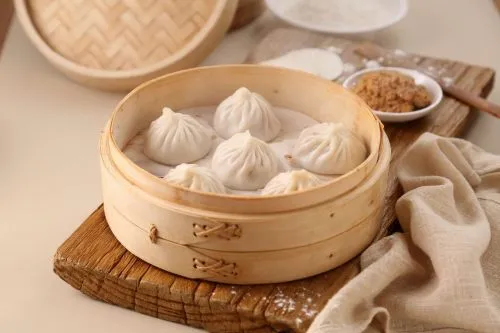
A steamer of pork xiaolongbao (鲜肉小笼) is the center, as at any tangbao shop. The Lao Sheng Xing version sits in the everyday style: slightly thicker skin than the famous houses, straightforward pork filling, enough juice to require the careful first bite, no pretense. It is breakfast, not a ceremony, and the kitchen’s consistency is the product — the steamer at the Zhenning Road flagship tastes like the steamer at the Mengzi Road branch, which is the entire promise of the format.
The sides are where this chain earns its sit-down keep:
- Scallion-oil noodles (葱油拌面). The benbang classic — noodles tossed in slow-fried scallion oil and soy. A tangbao shop’s version is usually simple and correct, and this is a reliably good one. Our scallion oil noodles guide covers what separates the great bowls; chain-tier versions land closer to “good,” which at 7 a.m. is plenty.
- Wonton soup (馄饨). The small, silky kind in a clear broth — the safe side order and the one to pick for cautious eaters.
- A soy milk or a soup completes the breakfast set; a steamer plus one side runs ¥20–25 per person.
Vinegar and the ginger jar are on the table. The ritual is the same citywide: nibble, sip, dip, repeat.
Why choose this one
Three practical reasons. First, hours: branches open at 6 a.m., every day, a schedule you can plan a sunrise around. Second, the rooms: calm, lit, clean — a place to sit with a bowl for thirty minutes without the counter-service turnover of the smaller chains, and with the thick soy milk locals drink slowly. Third, placement: the Mengzi Road branch sits near Madang Road station between the Tianzifang and Xintiandi tourist nodes, close enough to both to be the breakfast before either, without either’s queues. The Zhenning Road flagship, on a quiet Jing’an street, is the one locals name if you ask.
The rivalry, settled honestly
Lao Sheng Chang has more branches and a slightly faster counter rhythm; Lao Sheng Xing has the calmer rooms and, partisans insist, the better ginger. The differences are real but small, and both sit firmly in the everyday tier of our xiaolongbao guide — above the ¥10 budget chains, below the destination houses. The correct move for a visitor staying a week: eat both once each, order identically, and file your own verdict. It is the cheapest genuinely fun food comparison in Shanghai.
A morning built around the flagship
The Zhenning Road branch sits on one of Jing’an sleepiest and prettiest blocks, and the correct plan is to make that the point. Arrive at 7:30, take a table, and eat slowly: a steamer, the scallion-oil noodles, the thick soy milk locals drink like coffee. When you surface, walk one block south to Yuyuan Road — the old lane street that runs east toward Jing’an Temple through the best-preserved stretch of Shanghai’s lane-house fabric — and follow it all the way to the temple’s golden roofs, stopping for whatever breakfast windows are still steaming. It is forty minutes of walking through the neighborhoods this guide’s chain pages keep pointing at, and it starts with the calmest soup-dumpling room in the city.
Menu notes and what to skip
The safe core is pork xiaolongbao, wontons, scallion-oil noodles, soy milk; the crab version (蟹粉) appears in late autumn and is worth its premium only then. Skip the fried-rice and noodle-soup entries that pad the menu at some branches — the kitchen’s attention lives in the steamers and the scallion oil. Skip, also, ordering a second steamer before the first arrives: the pacing here is sit-down, the steamers come fast, and over-ordering is the standard tourist error at every tangbao counter in this guide. One practical note for groups: this is the tangbao chain with tables that absorb four people and a stroller gracefully, which is a rarer quality in this category than it should be.
Good to know
- It is not related to 老盛昌 — separate companies, overlapping concept. Do not ask the staff to settle it; they have heard the question.
- Menus are Chinese with photos at the counter. 小笼 plus fingers works; the order phrase above covers a full breakfast.
- Hours run 6 a.m. to 9 p.m., with morning the strongest service and the steadiest steamers.
- Sit-down means table numbers: order at the counter, sit, and the food finds you — slightly different from the counter-shout pattern of the smaller chains.
- Going with a group? This is the tangbao chain with the tables to absorb one.
Practicalities
Hours run 6 a.m. to 9 p.m. daily at the branches above — earlier than the tourist houses, later than the bun counters, and the calmest tables are between 7 and 8:30, when the room is full but the turnover is slow. Ordering is at the counter with a table number; payment QR or cash; and the larger branches have the space for strollers and groups that the budget chains lack, which is a quiet argument for this one when breakfast includes the whole family. The soy milk here is the thick kind, served hot — drink it slowly, the way the regulars stretch a breakfast — and the pickled ginger jar on the table refills the little dish without asking. Delivery apps cover this chain heavily at lunch; the eat-in morning is the better experience, and the one the kitchen respects most.
A note on the name
汤包 — “soup dumpling” — is technically a different dish from xiaolongbao: the classic tangbao of the Yangtze region is larger, holds more broth, and in its famous oversized form arrives with a straw. In everyday Shanghai usage, though, 汤包馆 has simply come to mean “soup-dumpling shop,” and the baskets that arrive are xiaolong-size. Order without anxiety; the shop is using the word the way the city does. The useful residue of the terminology is a reminder that the soup-dumpling family is wide — Nanxiang’s straw-sized giants at one end, these everyday steamers at the other, and a whole taxonomy of thickness and fillings between — and that Shanghai eats its way across the entire range in any given week, mostly at counters like this one.
What to order
Pork xiaolongbao 鲜肉小笼
The core order; juicy without being a soup bomb.
Scallion-oil noodles 葱油拌面
A common pairing at tangbao shops — see our guide to the dish.
Wonton soup 馄饨汤
Small, silky wontons; the safe side order.
Read more about the dishes
Central branches to try
A few well-placed branches picked from the map data — the chain has many more across the city.
Common questions
Is Lao Sheng Xing the same chain as Lao Sheng Chang?
No — despite the near-identical name, Lao Sheng Xing (老盛兴) is its own 54-branch chain, the near-twin rival of Lao Sheng Chang (老盛昌). Both sell the same Shanghainese soup-dumpling breakfast.
What should I order at Lao Sheng Xing?
The pork xiaolongbao (鲜肉小笼) — juicy without being a soup bomb — is the core order, with scallion-oil noodles (葱油拌面) or a small wonton soup alongside as the standard partners.
Which branch is easiest to reach by metro?
Two of the three — Lingling Road in Xuhui is by Dong'an Road station exit 2, and Mengzi Road in Huangpu is by Madang Road station exit 3. The Zhenning Road branch in Jing'an has no metro note in the data.
How much is breakfast at Lao Sheng Xing?
¥20–30 per person, and a calm sit-down breakfast — a steamer plus a side — works out to about ¥25.
What are Lao Sheng Xing's opening hours?
All three branches listed, in Jing'an, Xuhui and Huangpu, keep the same daily 06:00–21:00. Early enough for breakfast, closed well before midnight.