Lao Sheng Chang Tangbao
老盛昌汤包 · Lǎoshèngchāng Tāngbāo
Chain at a glance
- Category
- Buns & Dumplings
- Branches in Shanghai
- ~99
- Typical spend
- ¥18–28 per person
- Payment
- Cash / Alipay / WeChat
- English menu
- Point to order
Show this to order
一笼鲜肉小笼,一碗小馄饨
yi long xian rou xiao long, yi wan xiao hun tun · One steamer of pork xiaolongbao and a small wonton soup
Lao Sheng Chang is what a Shanghainese breakfast looks like when it is run like a modern business: clean bright shops, early hours, standardized kitchens, and a menu short enough to master on one visit. The chain runs around 100 branches across the city, and unlike the famous old xiaolongbao houses of the tourist quarter, it is priced and paced for a workday morning — you will be fed within ten minutes of walking in, for about ¥20, sitting among people with somewhere to be.
The word 汤包 in its name means “soup dumpling,” and that is the honest summary of the menu: this is a chain for eating xiaolongbao — the small, thin-skinned dumplings full of hot broth — on a Tuesday, not a chain for ceremonies. Our xiaolongbao guide covers the destination houses; this page covers the everyday tier, which is the tier Shanghai actually lives on.
The order
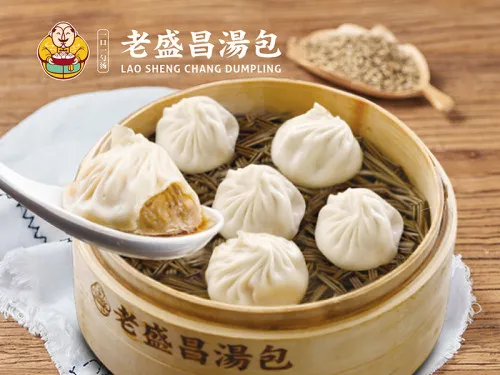
A steamer of pork xiaolongbao (鲜肉小笼) is the center. Eight to a basket at most branches, pleated thin, sitting on their napa leaf, arriving at the table in the bamboo they were cooked in. The skins are a touch thicker than the museum-piece dumplings of Nanxiang — a deliberate choice, because these are made in central kitchens and steamed by shop-level staff rather than pleated by a thirty-year veteran — and the filling is juicy rather than explosive. A workday dumpling, in the best sense: consistent, honest, hot.
The standard partner is a small bowl of wontons (小馄饨) — thin-skinned, floating in a clear broth with seaweed and a scatter of scallion. The two together — one steamer, one soup — are the complete order and cost around ¥20–25. In late autumn, look for the crab-roe version (蟹粉小笼), richer and a few yuan more, worth doing during hairy-crab season and easy to skip outside it.
Vinegar and ginger are on the table, self-serve from a jar. The local ritual: a dumpling onto the spoon, a nibble in the side, a sip of soup, then the rest dipped in vinegar with a shred of ginger. Give the first one a moment — the broth inside is scalding, and the burn is a rite of passage every xiaolongbao eater pays once.
When to come
Branches open at 6 or 6:30 a.m., earlier than nearly everything except the bun counters. The peak is 7 to 9, with a second wave at noon: office workers, schoolkids, retirees conducting the morning’s most important social business over steamers. Afternoons are quiet, and some kitchens pause the steamers in the mid-afternoon lull — morning remains the safest bet for the full menu.
The branch inside Shanghai Railway Station’s second floor runs until 10 p.m., which makes it a practical pre-train meal; the Chifeng Road shop in Hongkou and the Dapu Road shop in Huangpu are the neighborhood versions, small and fast and entirely local.
The tangbao landscape
Lao Sheng Chang’s nearest rival is a chain with a nearly identical name, Lao Sheng Xing — separate companies, overlapping menus, similar green-and-white shops. Asking which is better is a reliable way to start a conversation with any Shanghai local over forty; the answers are fully confident and fully contradictory. The practical strategy is proximity: eat at whichever one is closer, and order the same thing at both before forming an opinion.
Below this tier sits A Bing Tangbao, cheaper and rougher; above it, the famous houses of the old city and our six-shop list in the xiaolongbao guide. The everyday chains are where the volume is — this is the tier that lets a city eat soup dumplings twice a week instead of twice a year.
How a visit works
Order at the counter from the wall menu or the photo display — say the order phrase from this page, or point and hold up fingers for steamers. Take a number if the shop is busy, find a table, and the steamers arrive when ready. Payment is QR code at the counter, cash accepted. Shops have real tables and chairs, which puts them a step up from the counter-only bun shops for anyone who wants to sit down properly at 7 a.m.
A station-to-city morning
The Shanghai Railway Station branch turns a travel day into a food day. The shop sits on the station’s second floor — order a steamer and the wonton soup an hour before a morning train, and you eat the city’s breakfast while the departure boards flip behind you. The inverse is better: arrive in Shanghai by early train, exit into the station concourse, eat here before the taxi queue, and start the trip fed for ¥25. And on ordinary days, the Dapu Road branch in Huangpu is the neighborhood version — a five-minute walk from the Tianzifang edge of the old lanes, early enough to beat that neighborhood’s crowds by two hours, which is the correct way to see it.
Menu notes and what to skip
The core order — one steamer of pork xiaolongbao, one small wonton soup — is enough food, and adding the crab version in season is the only upgrade most tables need. Skip the noodle-soup mains at the bottom of some boards; they exist for completeness, and the xiaolongbao guide explains why the steamers deserve the attention instead. One useful move for families and cautious eaters: the wonton bowl alone is a complete, unadventurous meal — silky, mild, no technique required — which makes this chain one of the few in the guide that can absorb a nervous eater without a second restaurant. Ginger and vinegar are on the table; the ginger jar refills are self-serve and no one monitors the ratio.
Good to know
- Go before 9 for the full scene and the freshest steamers.
- One steamer each is the right math, plus one soup to split per two people. Order more only after the first round lands.
- It is not related to 老盛兴 despite the name — separate companies, nearly identical concept. Proximity decides.
- Menus are Chinese with photos at the counter. 小笼 plus fingers works everywhere.
- Hours run 6 a.m. to 8:30 or 9 p.m. at most branches, with morning the strongest service — this is breakfast culture operating on breakfast hours.
Practicalities
Branches open at 6 or 6:30 a.m. and close by 8:30 or 9 p.m.; the railway-station branch runs later. Payment is QR or cash, ordering is at the counter with the photo display as the fallback menu, and tables are find-your-own after the order. The shops are bright, small, and family-tolerant — high chairs appear on request at the larger branches, and the wonton bowl covers the cautious eater. Steamers for takeaway travel well in their bamboo, a common sight on the morning metro. If you are comparing the tangbao chains in this guide, keep the variables matched: same filling, same hour, same vinegar — otherwise you are grading the morning, not the dumpling.
Why chains took over tangbao
Soup dumplings look like the least chain-able food in China — hand-pleated, soup-filled, unforgiving — yet the everyday market belongs to chains like this one. The reason is the central kitchen: dough and fillings can be made to a standard off-site, leaving the branch only the pleating, the steaming, and the morning rush. The famous houses kept everything in the room and charged accordingly; the chains split the labor and priced for Tuesday. That is the entire economic story of this tier — a dumpling that tastes handmade because most of it is, at a price that assumes you eat it weekly. Judge the chain by that bargain, not by the houses’ standard, and it is hard to leave disappointed.
What to order
Pork xiaolongbao 鲜肉小笼
Small soup dumplings, steamed to order — the core order here.
Crab-roe xiaolongbao 蟹粉小笼
A seasonal richer version; best in late autumn.
Small wonton soup 小馄饨
Silky wontons in a clear broth — the side that makes it a meal.
Read more about the dishes
Central branches to try
A few well-placed branches picked from the map data — the chain has many more across the city.
Common questions
What should I order at Lao Sheng Chang?
A steamer of pork xiaolongbao (鲜肉小笼), the small soup dumplings steamed to order, with a side of silky small wontons in clear broth. In late autumn the crab-roe xiaolongbao (蟹粉小笼) is the seasonal richer upgrade.
Is there a Lao Sheng Chang near Shanghai Railway Station?
Yes — on level 2 of the station complex at 303 Moling Road, Jing'an, open daily 07:00–22:00. Useful cover for an early train or a late arrival.
How much is breakfast at Lao Sheng Chang?
¥18–28 per person. A steamer of xiaolongbao plus the small wonton soup — the core order — lands inside that band.
When do Lao Sheng Chang branches open?
Early, from 06:00 at the Chifeng Road shop in Hongkou, 06:30 at Dapu Road in Huangpu, and 07:00 at Shanghai Station in Jing'an. All close between 20:30 and 22:00.
What do I show to order at Lao Sheng Chang?
一笼鲜肉小笼,一碗小馄饨 (yi long xian rou xiao long, yi wan xiao hun tun) — one steamer of pork xiaolongbao and a small wonton soup. No English menu is listed; cash, Alipay and WeChat are accepted.