Jiang Guanliang Pickled Greens Noodles
蒋关良·咸菜肉丝面 · Jiǎng Guānliáng Xiáncài Ròusī Miàn
Chain at a glance
- Category
- Noodles
- Branches in Shanghai
- ~113
- Typical spend
- ¥18–28 per person
- Payment
- Cash / Alipay / WeChat
- English menu
- Point to order
Show this to order
一碗咸菜肉丝面,加个蛋
yi wan xian cai rou si mian, jia ge dan · One pickled-greens pork noodle soup, add a fried egg
Some chains expand by adding everything to the menu until nothing is particularly good. Jiang Guanliang went the other way: it built more than a hundred shops around a single bowl, 咸菜肉丝面 — noodles in a light pork broth with salt-cured mustard greens and slivers of pork. That bowl is one of Shanghai’s canonical comfort breakfasts, sour enough to wake you up and cheap enough to become a habit, and the chain’s entire design serves it: small shops, short menus, hours that start before seven, and prices that have barely left the twenties.
For a visitor, this is the chain to learn when you want the breakfast locals actually eat on a workday — not the famous houses with queues and history, but the bowl that office workers and retirees have eaten weekly for decades. It is also one of the easiest orders in this guide: one dish name covers the whole experience.
The bowl
The pickled greens do the heavy lifting. They are mustard greens (雪里蕻, the same xuecai behind our pickled greens noodle guide) salted until firm, faintly sour, and intensely savory — the cure keeps them green and crisp and gives the broth a tang that fresh vegetables simply cannot provide. Scattered through the bowl with fine shreds of pork, they turn a plain soup noodle into something with an actual point of view: salty, sour, warming, and gone in five minutes.
The pork is scattered, not piled — this is a ¥15–20 bowl, not a banquet — and the broth is light, more seasoned water than stock, which is exactly the point. This is restorative cooking, not restaurant cooking. The noodles are the thin wheat kind, cooked through but not limp, and the regulars’ finishing touch is a splash of black vinegar and a spoonful of the chili at the table.
Two versions exist at most branches: soup (汤面) and dry-mixed (拌面), the same toppings tossed through the noodles with a concentrated sauce instead of broth. Regulars split on which is correct. The soup version is the classic and the better first order; the dry version is what people get in summer.
The shops
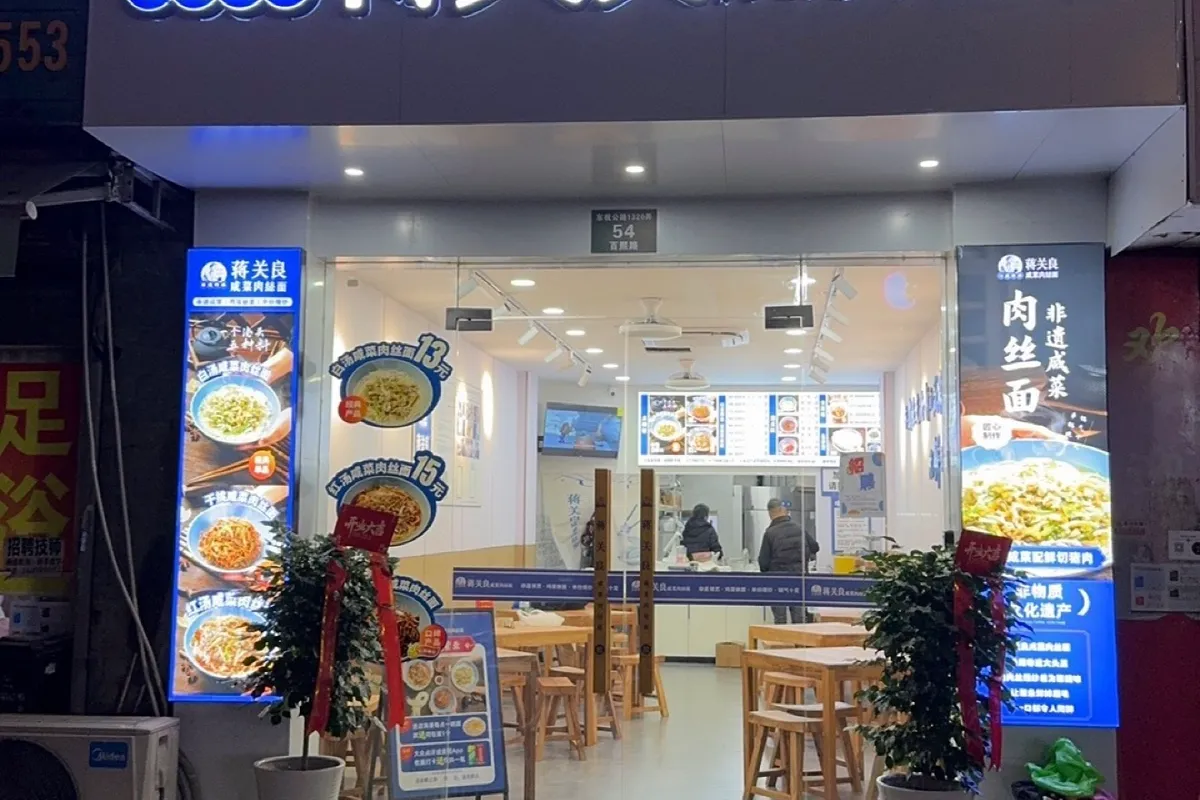
A Jiang Guanliang branch is a neighborhood noodle counter: one room, formica tables, a wall menu in Chinese, and a kitchen visible through the pass. Shops open between 6:30 and 7 a.m. and stay busy until mid-morning, settle into a lunch rush at noon, and wind down by early evening. The crowd is overwhelmingly local — workers, students, retirees reading newspapers over a bowl, delivery riders demolishing one in four minutes on the stools by the door. Nobody speaks English and nobody needs to: the transaction is one dish name and a finger count.
Branches are concentrated in residential Huangpu, Jing’an, and Hongkou — inside the neighborhoods, not on the tourist arteries. That is its own recommendation: if you are staying in an apartment rather than a hotel, the nearest one is probably a five-minute walk, and breakfast there costs what breakfast should.
Ordering without Chinese
The trick at a single-dish shop is that you barely need language. Say the dish name — xiancai rousi mian, the phrase at the top of this page — or show the characters 咸菜肉丝面 from your phone. Then three optional words:
- 汤 (tang) or 拌 (ban) — soup or dry-mixed.
- 加蛋 (jia dan) — add a fried egg, which arrives soft-centered on top of the noodles and is the standard upgrade.
- 不要辣 (bu yao la) — no chili, if you want to skip the table sauce.
Pay by QR code at the register or after the meal; both patterns exist across branches. A bowl with an egg runs ¥18–22.
How it fits the Shanghai breakfast picture
The city’s breakfast canon runs on starch, salt, and speed — the Four Kings at the bun counters, soup dumplings at the tangbao chains, and bowls like this at the noodle shops. What the noodle bowl adds that the others don’t is vegetable — the pickled greens are the closest thing to a vegetable most Shanghai breakfasts contain — and heat in liquid form, which matters more than you would think in a January wind.
If you are building a breakfast crawl: a xiaolongbao steamer at Lao Sheng Chang, then this bowl two streets over, is a genuinely Shanghai morning, and the two together cost less than ¥35.
An old-city loop that starts with noodles
The Zhizaoju Road branch sits at the edge of the old city’s west side, where the lane fabric survives between the redeveloped blocks. The plan: a bowl at 7:30 — the shop opens at 6:30 and the broth is at its best early — then walk east through the lanes toward the Confucian temple and the old-book market streets, a stretch of the city that tour buses cannot enter and tours do not narrate. The loop surfaces at Xiaonanmen’s metro station, where the 24-hour Ji Xiang branch makes a second, contrasting breakfast if the morning has room for one. Two bowls, two neighborhoods, under ¥40 — the cheapest genuine immersion available in central Shanghai.
Menu notes and what to skip
The board is a lesson in restraint: the namesake bowl in soup and dry versions, a couple of sibling noodle dishes, toppings. Lean into it. The skip list: the impulse to order the largest bowl — the broth is light by design, and volume flattens it; the fried-rice plates some branches run at lunch, which are filler between two noodle worlds; and the chili oil on the first visit — taste the broth before seasoning, because its whole point is the pickled greens’ tang, which heat masks. The additions that earn their money: the fried egg, always, and a side of the pickled greens themselves where offered, which turns the bowl’s supporting flavor into its own small dish. Regulars finish the soup version with the black vinegar splash; try the bowl both ways before deciding which camp you are in.
Good to know
- Go before 9 a.m. for the full experience — the shop at its busiest, the broth at its freshest, the neighborhood at its most itself.
- The dry version is not worse, just different. Order it on a second visit when the weather is warm.
- Add the egg. It is the single most common upgrade for a reason.
- Seating is minimal and shared. Expect to be seated next to strangers at peak hours, which is part of the point.
- Menus are Chinese-only, but the entire menu is essentially one dish plus toppings — point at someone else’s bowl if all else fails, a move that works across Shanghai.
And a last practical note: the bowls arrive fast and the tables turn faster — a solo breakfast here takes twenty minutes from door to street, which makes it the most schedule-friendly morning meal in this guide’s noodle chapters. Pairs with a morning walk, a train to catch, or a stubborn habit.
The bowl’s pedigree
咸菜肉丝面 is a dish with no invention story because it never needed one: it is what a Jiangnan household does with a jar of salted greens and a small piece of pork, moved from home kitchens to noodle counters sometime in the last century. The chain era added nothing to the recipe and removed nothing but the wait — which is the honest reason a bowl this simple survives franchising. Restaurants with complicated dishes translate badly into chains; restaurants with one perfectly ordinary bowl translate perfectly, because ordinary was always the product. Eat it with that in mind and the modest room, the short menu, and the ¥18 bill stop reading as limitations and start reading as the point.
What to order
Pickled greens pork noodles 咸菜肉丝面
The namesake bowl — salty-sour greens and pork shreds in a light soup.
Added fried egg 加荷包蛋
A common topping that makes the bowl breakfast-complete.
Dry-mixed version 拌面
Same toppings, no soup — the sauce clings to the noodles instead.
Central branches to try
A few well-placed branches picked from the map data — the chain has many more across the city.
Common questions
What is the one bowl to order at Jiang Guanliang?
The namesake pickled-greens pork noodles (咸菜肉丝面) — salty-sour cured greens and pork shreds in a light soup. Add a fried egg (加荷包蛋) to finish it, or order the dry-mixed version (拌面) if you would rather skip the soup.
How much is a bowl at Jiang Guanliang?
¥18–28 per person. The base noodle bowl sets the floor of the range, and the added fried egg — the common topping that makes the bowl breakfast-complete — costs little more.
When do Jiang Guanliang branches open?
Early, at 06:30 on Zhizaoju Road in Huangpu and Sanmen Road in Hongkou, and 07:00 on Pingxingguan Road in Jing'an. Closing times run from 20:30 to 22:00.
How many Jiang Guanliang shops are there in Shanghai?
The Amap count is 113 — neighborhood shops serving the bowl from dawn, with the representative branches here in Huangpu, Jing'an and Hongkou.
How do I order at Jiang Guanliang?
Show 一碗咸菜肉丝面,加个蛋 (yi wan xian cai rou si mian, jia ge dan) — one pickled-greens pork noodle soup with an added fried egg. There is no English menu; cash, Alipay and WeChat all work.