Ji Xiang Wontons
吉祥馄饨 · Jíxiáng Húntun
Chain at a glance
- Category
- Buns & Dumplings
- Branches in Shanghai
- ~84
- Typical spend
- ¥15–25 per person
- Payment
- Cash / Alipay / WeChat
- English menu
- Point to order
Show this to order
一碗荠菜鲜肉馄饨
yi wan ji cai xian rou hun tun · One bowl of shepherd's-purse and pork wontons
Ji Xiang (“auspicious”) is a wonton shop with a corporation behind it — one of the earliest franchise snack chains in China, started in Shanghai in the 1990s when standardizing a bowl of wontons was a genuinely novel idea, now running more than 80 branches in the city and a national network beyond it. The concept solves a real problem for the visitor, too: wontons come in every filling you could want, in three portion sizes, from kitchens that open early and close late — including a handful of 24-hour branches, which at 11 p.m. elevates the chain from convenient to essential.
A bowl of large wontons here is comfort food with a menu: twenty-plus fillings, a clear broth, and enough local logic (which filling, which size, which seasonings) that ordering well is a small, learnable skill.
Reading the menu
The filling list runs long — usually on a backlit board above the counter, twenty or more options in Chinese. Three reliable anchors:
- 荠菜鲜肉 (shepherd’s-purse and pork). The Shanghai standard and the filling most locals default to. Shepherd’s purse is a wild green with a grassy, faintly bitter edge that cuts the pork; it appears across Shanghai cooking in spring, but in wonton freezers it is year-round. If you order one bowl in this city, order this one.
- 三鲜 (three delicacies). Pork, shrimp, and vegetable in one wrapper — the crowd-pleaser for tables that cannot agree.
- 虾仁 (whole shrimp). Small shrimp folded into the pork, a notch up in price, and the bowl that converts people who think wontons are bland.
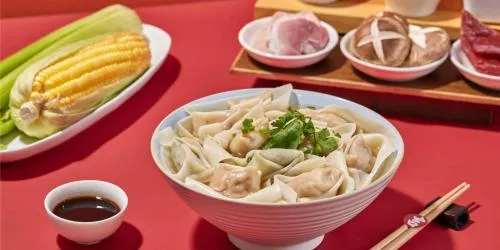
The wontons themselves are the large Shanghainese kind — fat folded parcels, almost dumpling-sized, in a light clear soup — not the small silky wontons (小馄饨) that float in breakfast broths elsewhere in this guide. Both are correct; they are different foods with the same name, and the large kind is a meal.
The portion-size ritual
Bowls come in three sizes, marked 小 / 中 / 大 (small / medium / large). The math that matters: a medium bowl is about a dozen wontons and is a full meal for most adults; a large is for the genuinely hungry, and a small is a snack or a child’s portion. First-timers reliably over-order — go medium, and add a second bowl only if the first disappears too fast. A medium runs ¥15–20 depending on filling.
The soup base is mild pork broth; the table condiments — white pepper, black vinegar, chili oil — are where the bowl gets finished, and regulars are generous with the pepper. In summer some branches offer cold-dressed wontons, the same parcels with a sesame sauce; worth trying if you see them on the board.
The 24-hour question
Several branches run around the clock, and the Zhonghua Road shop near Xiaonanmen station — in the old city, a short walk from the Yu Garden tourist zone — is the flagship of that habit. At 2 a.m. its room is a cross-section of the city’s late shift: taxi drivers between fares, delivery riders after the last order, night-owl students. The wontons are the same as at 8 a.m., which is the entire point of the chain’s existence: the bowl is standardized, so the clock doesn’t matter.
Other branches typically run 7 a.m. to 10 p.m. — the map data in the branch list marks the 24-hour ones. If you are staying in the old city, memorize the nearest one before your first late night.
How a visit works
Order at the counter — say the filling and the size, or point at the board. Pay by QR code. Take a seat; the bowl arrives in a few minutes since wontons cook fast. Shops are simple: formica tables, a water urn, the condiment set. The Zhonghua Road branch has actual space; some neighborhood branches are a counter and six stools.
A late-night map of the old city
The Zhonghua Road branch earns its place in a visitor’s memory by geography as much as by wontons: it sits inside the old city’s street grid, minutes from Yu Garden’s tourist glow but on the streets where the neighborhood actually lives, and it runs around the clock. The deployments that matter: the 1 a.m. bowl after a long day, when the room is taxi drivers and kitchen staff from the closed restaurants nearby; the 6 a.m. bowl before the old city wakes, when the steam off the pot is the only light on the block; and the jet-lag special — 4 a.m., wide awake and hungry, in a city that mostly pretends to sleep. Very few foods are improved by their hour; the large-wonton soup at dawn is one of them.
Menu strategy for a long board
Twenty fillings is an invitation to order badly. The strategy that works: anchor every table with one shepherd’s-purse bowl, add one three-delicacies for the cautious, and spend the third order on whatever the board lists as seasonal or new — the kitchen flags its own interests that way. Skip the combination “everything” bowls some branches offer; the fillings are designed to be tasted individually, and the mix reads as noise. Portion math once more, because it is the chain’s only real trap: medium feeds an adult, large feeds a hungry adult, and two smalls cost more than one medium for less food. The soup additions — extra seaweed, a drop-seed egg — are cheap and good; the chili oil on the table is fine but the white pepper is the local answer.
Good to know
- Medium is the honest portion. Large is a challenge; small is a tease.
- 白胡椒 (white pepper) on the table is the local finishing move for the soup — more than seems reasonable.
- Vegetarian fillings exist (vegetable and mushroom varieties are standard on the board), though the broth is pork-based; ask for 清汤.
- It’s a chain, not a shrine. Come for dependable, cheap, and 24-hour-capable — for the once-a-year bowl, see the xiaolongbao guide instead.
- Compare against Zhu Yanwen, the handmade-wonton chain in this guide — fresher wrappers, shorter menu, fewer night hours. Different jobs, both done well.
Practicalities
The 24-hour branches are marked on the map listings with 全天 hours; the rest open around 7 or 8 a.m. and close by 10 p.m. — check before planning a late bowl. Payment is QR or cash, ordering is counter service from the wall board, and the busiest branches post a photo menu beside it that solves the reading problem. The shops are simple but real — tables, chairs, a water urn — and the larger ones absorb families easily. Delivery is a major part of the chain’s business, so expect a counter traffic of riders; the eat-in pace is calmer than the takeaway line. For the full local finish, remember the sequence: white pepper first, vinegar second, and the chili oil only if the bowl has asked for it.
The chain’s place in history
Ji Xiang matters beyond its bowls for a bureaucratic reason: it was one of the first snack foods in China to be standardized, franchised, and quality-controlled at national scale, in an era when “franchise” meant little in Chinese food. The large wonton it sells — the fat, folded, filling-forward kind — is the Shanghainese tradition it carried across the country; the 24-hour shop is the habit it normalized. Eating at one today, you are eating the endpoint of a 1990s experiment in whether a bowl of wontons could be run like a modern business. The answer, eighty Shanghai branches later, appears to be yes — and the wontons, it should be said, held up their end.
What to order
Shepherd's-purse pork wontons 荠菜鲜肉馄饨
The Shanghai classic — a grassy, green filling locals order by default.
Three-delicacies wontons 三鲜馄饨
Pork, shrimp, and vegetables in one wrapper.
Shrimp wontons 虾仁馄饨
Whole small shrimp in the filling; a notch up in price.
Central branches to try
A few well-placed branches picked from the map data — the chain has many more across the city.
Common questions
Which wonton filling should I choose at Ji Xiang?
The Shanghai default is shepherd's-purse and pork (荠菜鲜肉馄饨) — a grassy, green filling. Three-delicacies (三鲜) combines pork, shrimp and vegetables, and shrimp wontons (虾仁馄饨) are the pricier step up.
Is Ji Xiang Wontons open late at night?
Yes. The Zhonghua Road branch in Huangpu is open 24 hours and the Wenxi Road shop in Jing'an runs 07:00–24:00. The Liangcheng Road branch in Hongkou keeps daily 08:00–22:00.
How do I get to the 24-hour Ji Xiang branch?
Take the metro to Xiaonanmen station and head for exit 2 — the round-the-clock branch is at 793 Zhonghua Road in Huangpu.
How much do wontons cost at Ji Xiang?
¥15–25 per person covers a bowl. Standard fillings sit lower in the range, while shrimp wontons, with whole small shrimp in the filling, are a notch up in price.
What if I cannot read the filling list?
Show 一碗荠菜鲜肉馄饨 (yi wan ji cai xian rou hun tun) — one bowl of shepherd's-purse and pork wontons, the local default. There is no English menu, so the phrase orders the bowl most Shanghai regulars pick.