Ma Ji Yong Lanzhou Noodles
马记永·兰州牛肉面 · Mǎ Jìyǒng
Chain at a glance
- Category
- Noodles
- Branches in Shanghai
- ~115
- Typical spend
- ¥30–42 per person
- Payment
- Cash / Alipay / WeChat
- English menu
- Point to order
Show this to order
一碗牛肉面,加一份牛肉
yi wan niu rou mian, jia yi fen niu rou · One beef noodle soup with an extra plate of beef
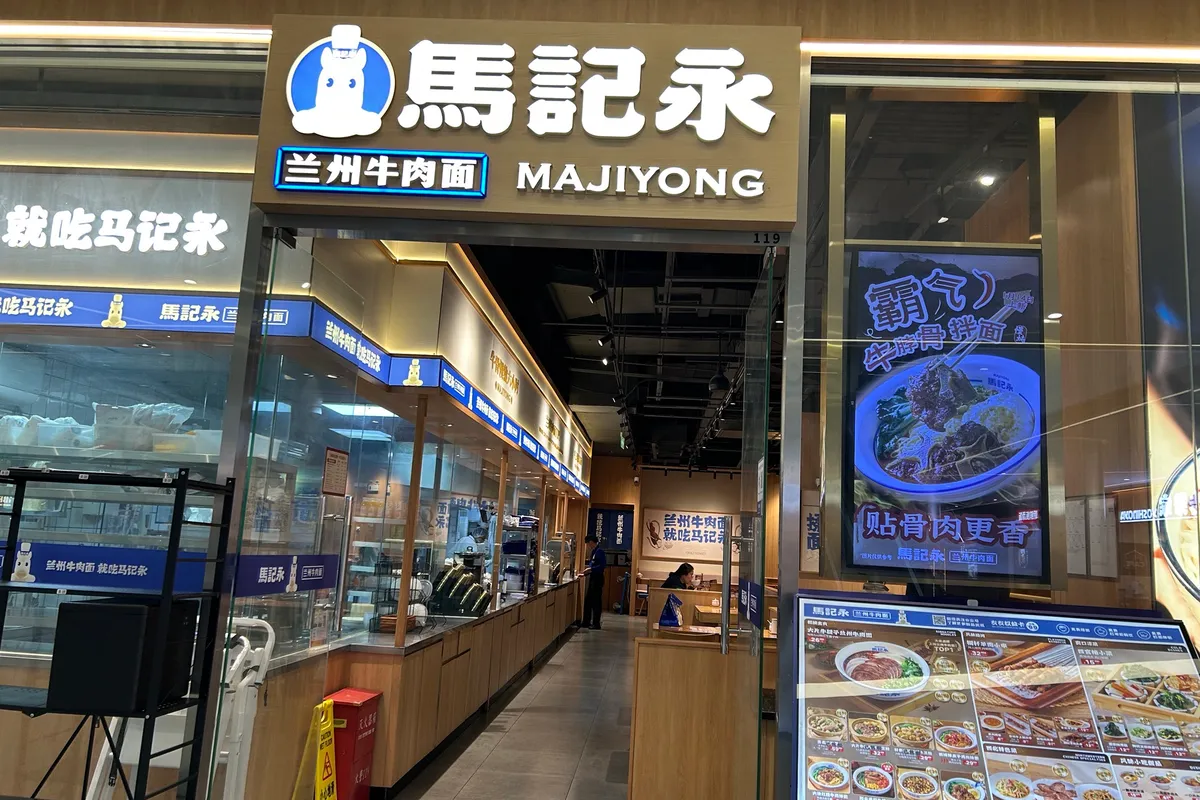
Ma Ji Yong is the other half of the new-wave lamian duo. Like Chen Xianggui, it grew fast in Shanghai in the late 2010s and early 2020s by doing one provincial dish — Lanzhou beef noodles — in polished mall storefronts: open kitchen, a cook pulling noodles to order, a broth that aims for the clear, aromatic standard of the real thing. It now runs well over 100 branches across the city, and at lunchtime in any major office district the queue outside one of them is a reliable crowd gauge.
The name, for the record, reads Ma Ji Yong — 马记永, a founder-style name in the pattern of old Lanzhou family shops. The chain is young, but it borrowed the naming grammar of a century-old noodle house, which tells you what it wants to be seen as: not a fusion experiment, but the Lanzhou original, scaled.
What distinguishes it
The honest answer: less than the fans of either chain will admit. Ma Ji Yong and Chen Xianggui serve near-identical menus — classic beef lamian, a short list of sides, a cold-appetizer counter — at overlapping prices, often in the same food courts. Both are good. What tips a visit one way or the other is usually the branch, not the brand: a freshly opened store with a new kitchen and a hungry local crowd will outperform a tired branch of the better brand every time.
Where Ma Ji Yong does have its own character: the dining rooms run a touch more spacious, with wider tables and a calmer setting that office workers actually sit down in for a proper lunch. The condiment station — chili oil, black vinegar, pickled greens — is help-yourself, so you season the bowl exactly as you like it, and the service flow (order at the entrance, buzzer at the table) is smoother than most of its competitors.
The bowl itself
The broth is beef bones simmered until clear and savory — not milky, not heavy — finished at the station with chili oil, cilantro, and scallion. The noodles are pulled to order, and you choose the width when ordering: 毛细 hair-thin, 二细 fine (the default), 韭叶 flat chive-leaf, or 大宽 belt-wide. If you have never eaten belt-wide noodles, this is a good place to try them; the pull is fresh, and the ribbons stay chewy to the last slurp.
The bowl arrives with a few thin slices of beef and translucent radish — honest to the Lanzhou original, where noodles and broth carry the meal. The upgrade that matters is the side plate of braised beef (the order phrase above includes it): seasoned, tender slices to dip in the broth or eat straight. Add a braised egg and a cold cucumber plate from the counter and you have assembled the full local lunch, usually still under ¥40.
How a visit works
Order and pay at the entrance — kiosks with pictures handle the language — take a buzzer, sit, and collect the bowl when it sounds. The open kitchen is the entertainment: a cook works a block of dough into noodles in seconds, slapping it against the counter with the sound that gives hand-pulled noodles their theater. Hours are mall hours, typically 10 or 10:30 a.m. to 9 p.m.; the Sino Biotech Plaza branch near West Nanjing Road and the Ruihong branch in Hongkou both run reliably busy at lunchtime, which is the best sign in any noodle shop.
Two branches, two days
The Infinite Plaza branch (B2, Xintiandi’s lakeside mall) is the lunch anchor for a French Concession day: noodles at noon, then the shikumen blocks and the plane-tree streets westward until dinner. The Sino plaza branch near West Nanjing Road does the same job for the shopping mile — order the bowl, watch the dough, and come out forty minutes later recharged for the second half of Nanjing Road’s length. The Ruihong branch in Hongkou, in the Sun Palace mall, is the weekend version: it anchors the mall that north Shanghai treats as its town square, and the noodle theater there — two cooks, continuous pulls, the line moving at food-court speed — is the best free show of the three.
Menu notes and what to skip
The core order needs little annotation: classic lamian, width of your choice, the beef add-on, one cold side. Around it, some fine print. The tomato-based broths that appear on seasonal menus are competent but generic — the beef broth is the reason the chain exists. The lamb skewers on some branch menus are a mall-priced version of a street classic; fine as a lark, never the reason to come. The one genuine upgrade beyond the beef plate is the braised egg from the cold counter, which costs almost nothing and improves the broth when the yolk dissolves into it. And a calibration note for the width choice: if you are splitting bowls among a group, order one fine and one belt-wide — the textures are different enough to be worth comparing, and the argument that follows is traditional.
Good to know
- Halal-friendly menus. Beef and lamb only, no pork anywhere on the menu, in keeping with Lanzhou’s tradition.
- Spice is self-serve. The chili oil goes on at the condiment station, so a no-spice bowl is trivially easy — just skip it.
- The braised-beef add-on is the difference between a snack and a meal. Order it on your first visit before you decide what you think of the chain.
- Comparing against Chen Xianggui? Order the same width and the same add-ons at both, or you are comparing two different meals. Locals will tell you this after you get it wrong.
- Mall hours, no breakfast. If you want morning noodles, the benbang noodle shops in this guide open at six.
Practicalities
Hours follow the malls — 10 or 10:30 a.m. to 9 or 10 p.m., with the Ruihong branch opening slightly earlier on weekends — and the busy windows are the office lunch (11:30 to 1) and the weekend family wave from noon. Kiosks handle the order with pictures; the buzzer finds you; and the free condiment station sits by the pass, which is where you finish the bowl to taste. Children are easy here — noodle widths are a novelty that lands, and the mild broth suits young palates. Families avoiding pork have a whole menu of options, a rarity in this guide’s chain chapters. If the branch you land at lacks a kiosk, the order phrase above plus the width word 二细 or 大宽 at the cashier covers the entire transaction.
Lamian, briefly
Lanzhou beef noodles carry a founding myth (a 1915 cook named Ma Baozi is the usual attribution) and a hard set of standards: the broth clear, the noodles pulled to order, the bowl finished with chili oil and cilantro at the counter. Lanzhou’s shops traditionally open at dawn and close early afternoon — it is a breakfast and lunch food in its hometown — and the new-wave mall chains inverted that schedule for office Shanghai. What the format preserved is the theater of the pull and the clarity of the broth, the two things that separate lamian from every other noodle in this guide. A visitor who eats one bowl here and one at an old-corner Lanzhou shop will notice the broth depth difference immediately — and also notice that the mall version’s floor is cleaner, which is the trade the new wave made on your behalf.
What to order
Classic beef lamian 兰州牛肉面
Choose your noodle width; the default is fine unless you speak up.
Braised beef slices 牛肉
Ordered as an add-on plate; the standard portion in the bowl is thin.
Chilled appetizers 小菜
Braised eggs, pickles, and cold vegetables by the counter.
Central branches to try
A few well-placed branches picked from the map data — the chain has many more across the city.
马记永·兰州牛肉面(瑞虹新天地店)
瑞虹路181号瑞虹新天地太阳宫LG层
Hongkou · Mon–Fri 10:30–21:00; Sat–Sun 10:00–21:00
Common questions
How do I order extra beef at Ma Ji Yong?
Show 一碗牛肉面,加一份牛肉 (yi wan niu rou mian, jia yi fen niu rou) — one beef noodle soup with an extra plate of beef. Worth doing, because the standard meat portion in the bowl is thin.
Which noodle width should I pick at Ma Ji Yong?
The beef lamian is hand-pulled to order and you choose the width — the default is fine unless you speak up at the counter. Er xi, the standard fine cut, is the safe choice for a first visit.
How much is Ma Ji Yong per person?
¥30–42. A classic bowl plus the braised-beef add-on and something from the chilled-appetizer counter — braised eggs, pickles, cold vegetables — is the typical full order.
Is Ma Ji Yong open for breakfast?
No. Branches open at 10:30 — 10:00 on weekends at the Ruihong shop — and close between 20:00 and 21:00, keeping mall lunch-and-dinner hours.
How many Ma Ji Yong shops are in Shanghai?
The Amap count is 115 branches, making it the other big new-wave lamian chain. The shops listed here are at Ruihong Xintiandi in Hongkou, Hubin Road in Huangpu and Bohua Plaza in Jing'an.