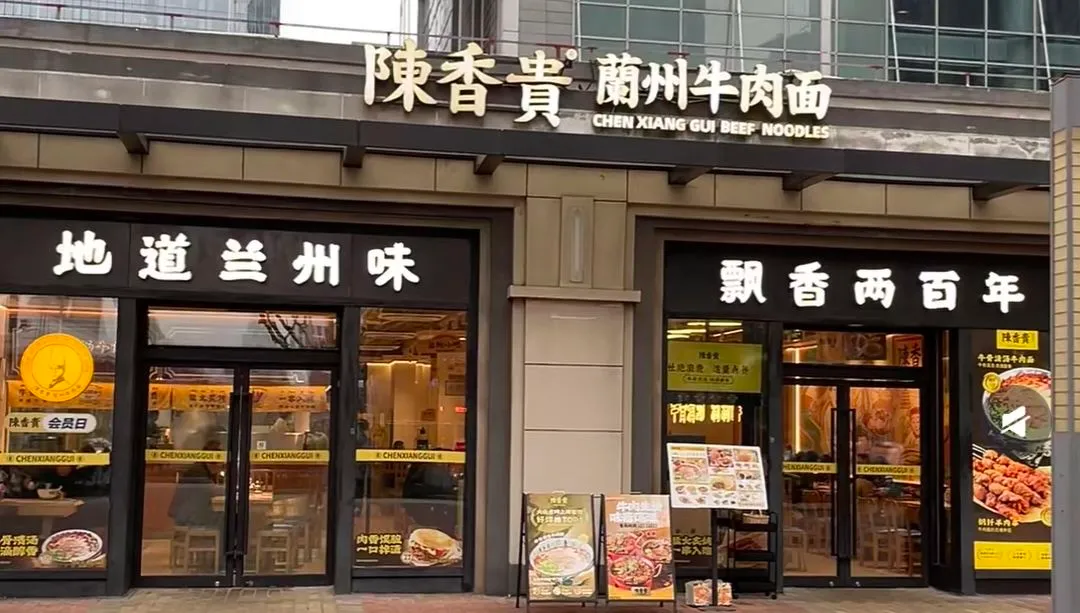
Chen Xianggui Lanzhou Noodles
陈香贵·兰州牛肉面 · Chén Xiāngguì
Chain at a glance
- Category
- Noodles
- Branches in Shanghai
- ~118
- Typical spend
- ¥28–40 per person
- Payment
- Cash / Alipay / WeChat
- English menu
- Point to order
Show this to order
一碗兰州牛肉面,二细
yi wan lan zhou niu rou mian, er xi · One Lanzhou beef noodle soup, fine noodles
Lanzhou beef noodles used to mean a cramped corner shop with a hand-written sign, a stack of plastic stools, and a cook who had trained for years in Gansu. Chen Xianggui is one of the chains that changed that: founded in Shanghai in the late 2010s, it moved lamian into bright mall storefronts with open kitchens, standardized broth, printed menus, and prices around ¥30 a bowl. There are now more than 100 branches in the city, mostly in shopping centers and office basements, and the format has proven so durable that the older corner shops increasingly copy it back.
The chain arrived as part of a broader shift in Chinese fast food — sometimes called the “new Chinese fast-casual wave” — where venture capital discovered that a bowl of noodles, done to a standard in a pleasant room, could scale like a burger chain. For a visitor, what that history means in practice is simple: this is the easiest place in Shanghai to eat a genuinely well-made bowl of Lanzhou lamian without a word of Chinese, a search mission, or a gamble on hygiene.
The noodle-width ritual
The one piece of vocabulary worth learning before you go: when you order, you pick the width of your noodles. This is not a gimmick — in Lanzhou it is the core of the order, and the kitchen pulls each bowl’s noodles to spec while you watch. The classic options, thinnest to widest:
- 毛细 (máo xì) — “hair-thin.” Soaks up broth fastest; softens as it sits, so eat quickly.
- 二细 (èr xì) — fine. The safe default and the most-ordered width. Chewy enough to have bite, thin enough to slurp.
- 三细 (sān xì) — medium-fine. Between the two, with a bit more chew.
- 韭叶 (jiǔ yè) — “chive-leaf,” a flat noodle the width of a scallion leaf. Good for broth lovers.
- 大宽 (dà kuān) — belt-wide ribbons. The most photogenic and the most fun to eat, with real chew; purists say it holds chili oil best.
If you say nothing, you will usually get fine. Saying the width when you order — the phrase at the top of this page ends with 二细 — marks you as someone who has done this before, and the cook will notice.
What you’re eating
The broth is the point of real Lanzhou lamian, and the new-wave chains invest heavily in it: beef bones simmered for hours until the soup is clear — not milky like tonkotsu — but deeply savory, with a faint sweetness from the bones. A properly made bowl has what Lanzhou cooks call the five colors: clear broth, white radish, green cilantro and scallion, red chili oil, and dark noodles. It reads as clean and restorative rather than rich and heavy, which is why lamian works as breakfast in Lanzhou and as lunch in Shanghai without either feeling wrong.
The beef in the standard bowl is sliced thin and modest in quantity — honest to the Lanzhou original, where the noodles and broth carry the bowl. If you want more protein, order the side plate of braised beef (加牛肉), which arrives cold or room-temperature, seasoned and ready to drop into the hot broth or eat alongside. The cold side counter by the register — braised eggs, pickled vegetables, cucumber salad, sometimes chilled tofu — is where regulars round out the meal; two sides plus the bowl still rarely crosses ¥40 per person.
Chili oil and cilantro are finished at a self-serve station in most branches, which means spice level is entirely yours to control. The oil is fragrant rather than fierce; even cautious eaters can start with a spoon and adjust up.
How a visit works
Order and pay at the entrance — at a kiosk with photos if your Chinese is shaky, or with the cashier if not — take a number, and collect your bowl when it appears on the screen. Total time from door to first slurp is usually under five minutes. The open kitchen runs along one wall, and it is worth watching: the cook takes a block of dough, folds and slaps it, and a few seconds later it is noodles. If you have never seen hand-pulled noodles made, this alone justifies the visit — it is one of the great free shows in Chinese cooking.
Hours follow the malls: doors open at 10 a.m. and close by 9 or 10 p.m. This is a lunch-and-dinner play; do not come looking for breakfast.
Chen Xianggui versus Ma Ji Yong
The obvious question, because the two chains sit in the same food courts with near-identical menus. The honest answer: less separates them than the fans of either will admit. Both do a solid bowl in the ¥28–40 range, both pull noodles to order, both let you choose width. Chen Xianggui’s dining rooms tend slightly more compact and its broth slightly more aromatic; Ma Ji Yong runs a touch more polished service. Whichever is closer to where you are standing is the correct choice — we cover Ma Ji Yong separately in this guide.
A Nanjing Road lunch plan
The Hengji Plaza branch sits at the pedestrian street’s eastern, Bund-facing end, and it solves the ugliest meal of the Shanghai visitor day: lunch on Nanjing Road, where the options are tourist traps and food courts of variable fortune. The working plan: walk the pedestrian section from People’s Square eastward with the morning crowd, divert into the mall’s basement when the hunger bites, order the classic bowl with a belt-wide pull and the beef plate, and come back up thirty-five minutes later for the last stretch to the Bund — fed for under ¥40, seated in air-conditioning, having watched a cook turn dough into noodles through the service window. It is not the trip’s most romantic meal; it may be its most reliable.
Menu notes and what to skip
Three notes for the board. The noodle-width choice is the whole game — if the table is ordering separately, coordinate: one fine, one belt-wide, one chive-leaf covers the spectrum and turns lunch into a tasting. The cold counter rewards a walk-around before you order the bowl: the braised eggs and pickles sit by the register, and taking two changes the meal’s shape for a few yuan. And the seasonal tomato broth that appears on some menus is competent but beside the point — the clear beef broth is the chain’s argument. Skip the sugary drinks in the chiller for the free hot water or a soy milk where offered; the broth is the drink. A last calibration: if your bowl arrives and the chili station is self-serve, add the oil in two passes, tasting between — the correct amount is less than the enthusiasm suggests.
Good to know
- Halal note. These are beef-and-lamb menus with no pork, in keeping with Lanzhou tradition — useful if you are avoiding pork.
- Mall hours, not street hours: 10 a.m. to 9 or 10 p.m., no breakfast.
- The braised-beef add-on is worth it. The standard bowl is mostly noodles and broth by design.
- Vegetarians: plain noodles in the beef broth are not meat-free. The cold sides — cucumber, pickles — are the workable picks, but this is not a vegetarian restaurant.
- Ordering screens have photos, so language is not a barrier — but saying 二细 or 大宽 earns you a nod from the cook.
What to order
Classic beef lamian 兰州牛肉面
Hand-pulled to order in clear beef broth — choose your noodle width.
Extra braised beef 加牛肉
The default meat portion is thin; adding a slice plate makes it a meal.
Cold side dishes 凉菜
A self-serve counter of chilled pickles and vegetables by the register.
Central branches to try
A few well-placed branches picked from the map data — the chain has many more across the city.
陈香贵·兰州牛肉面(上海黄浦恒基名人店)
南京东路300号恒基名人购物中心B1层
Huangpu · Daily 10:00–21:00 · Nanjing Rd East / People's Square area
Common questions
What should I order at Chen Xianggui?
The classic beef lamian (兰州牛肉面), hand-pulled to order in clear beef broth. Add a plate of braised beef (加牛肉) because the default meat portion is thin, and take pickles from the self-serve cold counter by the register.
How much does Chen Xianggui cost per person?
Roughly ¥28–40. The base lamian sets the floor, and the extra-beef plate plus cold sides are what push a single bowl toward the top of the range.
Is there a branch near People's Square?
Yes — the Huangpu branch is on B1 of the Hengji Mingren mall at 300 Nanjing Road East, in the Nanjing Road East / People's Square area, open daily 10:00–21:00. Two more listed branches are in Xuhui and Jing'an.
What are Chen Xianggui's opening hours?
Mall hours at all three branches — daily 10:00–21:00 on Nanjing Road East and 10:00–22:00 in Xuhui and Jing'an. It is a lunch-and-dinner chain, not a breakfast stop.
How do I choose a noodle width?
Say 二细 (er xi, fine noodles) as in the order phrase 一碗兰州牛肉面,二细, or point at the width options. There is no English menu, and er xi is the safe default most regulars land on.