A Qiao Guotie
阿跷锅贴 · Āqiāo Guōtiē
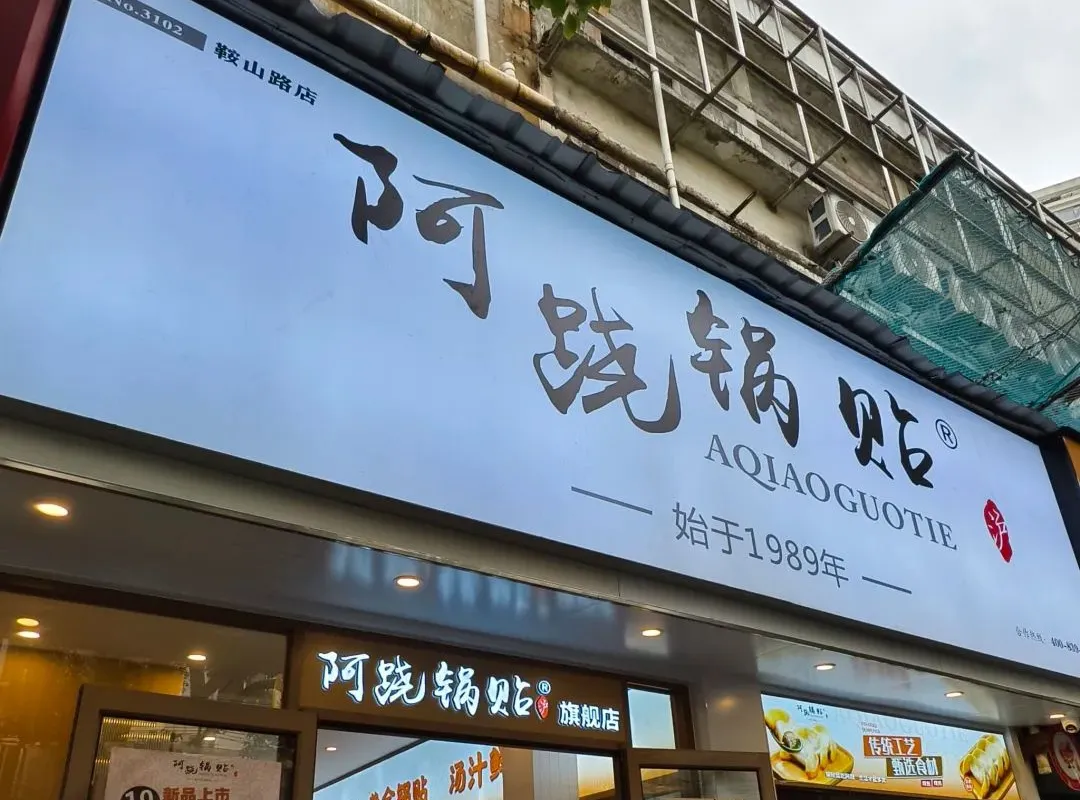
Chain at a glance
- Category
- Buns & Dumplings
- Branches in Shanghai
- ~91
- Typical spend
- ¥15–25 per person
- Payment
- Cash / Alipay / WeChat
- English menu
- Point to order
Show this to order
一两锅贴,一碗咖喱牛肉汤
yi liang guo tie, yi wan ga li niu rou tang · One liang of guotie and a curry beef soup
If shengjian is the dumpling you already know, guotie is its leaner cousin: the same pan-fried treatment, but with an unleavened wrapper, a straight cylindrical shape, and no soup inside — which makes them easier to eat, easier to carry, and easier to burn yourself on only moderately. A Qiao is one of the largest chains doing them, with around 90 branches, most of them modest corner shops that open at dawn and run the same play all morning: a wide black pan, a ladle of flour slurry, and a hiss you can hear from the end of the street.
The name — 阿跷, “A Qiao” — follows the old Shanghai pattern of nicknaming a founder, and the chain trades on exactly that sense of street-corner lineage. What it delivers at scale is the working breakfast version of it: guotie by the liang, soup by the bowl, change from a twenty.
Guotie versus shengjian, properly
The distinction matters enough to spell out, because the two dishes share a pan and a city. Shengjian (生煎) uses a yeasted, fluffy skin, round like a bun, and typically holds soup — our shengjian guide covers that school. Guotie (锅贴) uses a thin wheat wrapper, folded flat like a dumpling and sealed along the top, fried only on the base. No soup inside, no yeast, no ceremony: guotie are about the contrast between the blistered, almost cracker-like bottom and the soft steamed top, and about the pork filling, which is firmer and more intensely seasoned than shengjian’s because it doesn’t have broth to carry it.
At a good shop — and A Qiao’s better branches qualify — the pan is scalded, the dumplings are crowded edge to edge, and a thin slurry is poured in so the batch fries up with a lacy, continuous crisp sheet across the bottom. The cook shakes the pan once to release it, and the whole thing comes out as a crackling raft that gets cut into portions at the counter. If the bottom isn’t audible, you came at the wrong hour.
The pairing
Guotie do not travel alone in Shanghai. Their traditional partner is curry beef soup (咖喱牛肉汤) — a thin, mildly curried broth with a few slices of beef, thickened just enough to coat a spoon. The combination sounds odd to first-time visitors and works completely: the soup’s mild spice and warmth reset the palate between rich, fatty bites of fried dumpling, the same job black coffee does for a donut. Dumplings plus soup runs ¥15–20 at most branches, and it is a complete breakfast by any measure.
The other standard partner is duck-vermicelli soup at some shops; at A Qiao, curry beef is the house answer, and the order phrase at the top of this page is the full local order in one line.
Ordering by the liang
Guotie are sold by weight, the liang (两) — a unit inherited from grain markets that survives in exactly this context. A half-liang is roughly three or four dumplings; one liang, six or seven. One person eating light takes one liang plus soup; two people take three liang plus two soups and argue about the last dumpling. There is no shame in holding up fingers and saying 一两 or 二两; the counter staff do this arithmetic hundreds of times a morning.
Payment is QR code or cash; these are informal shops, and small notes are appreciated at the morning rush. Seating ranges from a few stools to a narrow row of tables, depending on the branch; the food travels well in its paper sleeve if you take the takeaway route.
When and where
Guotie shops are morning creatures. A Qiao branches open at 6 a.m., the pans come off in waves through the breakfast rush, and by evening the selection narrows to whatever the kitchen still feels like frying. The Zhenru branch deserves a special mention: it sits in the old temple-town streets of Putuo, one of the few surviving old street grids in that part of the city, and makes a pleasant loop — guotie, a wander past the Zhenru temple, and a metro ride back — for a morning when you want to see a neighborhood that tourism hasn’t rearranged.
The Huihe Road branch in Hongkou and the Yichuan Road branch in Putuo are the neighborhood versions: no English, no tourists, full value.
A Zhenru morning
The Zhenru branch is the one to travel for, and the walk around it is the reason. Zhenru is one of Shanghai’s oldest temple towns — its monastery predates the city’s famous districts by centuries — and the streets around the temple keep a street-grid character that most of central Shanghai lost decades ago. The plan: arrive at 7, eat guotie and curry soup at the counter on Nanjing Street (the old town’s main lane, confusingly named), then cross to the Zhenru Temple complex as it opens, incense smoke and retirees’ tai chi, and finish through the wet market streets to the west, where the neighborhood’s food economy — pickle vats, live fish, breakfast carts — operates in the open. Ninety minutes, one metro line from the city center, and an entirely different register of Shanghai than the Bund circuit.
What to skip, and the soup question
Skip the fried extras on the smaller boards; the pans and the soup pot are the kitchen’s real instruments. Within the order, the only decision that matters is the ratio — one liang of guotie to one soup per person is balanced, and adding a second soup for the table to share is the regulars’ move, because the curry broth is the part people remember. On the soup itself: it is mild, slightly starchy, and faintly sweet under the curry — closer to a Japanese curried soup than an Indian one, a colonial-era Shanghai hybrid that survives in exactly this pairing. If it sounds odd, order it anyway; it is the most historically interesting bowl in this chain’s repertoire, and at ¥6 it is also the cheapest lesson in the city’s food history on offer.
Practicalities, and the arithmetic
The per-liang pricing deserves one line of math because it surprises visitors: a liang of guotie and a soup together run ¥15–20, and the marginal cost of adding another half-liang for the table is under ¥10 — the cheapest round-two in this guide. That arithmetic makes A Qiao the natural base camp for a student’s or a family’s breakfast crawl: start here, split a second order, and walk. Payment is QR or cash; stools and small tables indoors, and the branches in older buildings can be dim, close, and wonderful. The Putuo branches anchor real neighborhoods where an English word has never been spoken at the counter, and a phone with the branch card above — Chinese name and address, fingers at the pan — handles the entire interaction. Go early, go twice, and judge the chain on its freshest batch, not its most convenient hour.
Good to know
- Order from the pan in front of you, not the back catalogue. A reheated guotie is not worth the discount.
- The soup is pepper-warm, not chili-hot. Safe for cautious eaters.
- Vinegar dispenser on the counter. The correct amount is “more.”
- Go before 9 a.m. for the crispest batches and the busiest room.
- Comparing against shengjian? Read the shengjian guide first — the two dishes are judged by different standards, and knowing which you are eating halves the confusion.
What to order
Guotie 锅贴
Straight pan-fried dumplings — thin wrapper, blistered crisp base.
Curry beef soup 咖喱牛肉汤
The classic guotie-shop pairing; mild, starchy, and warming.
Central branches to try
A few well-placed branches picked from the map data — the chain has many more across the city.
Common questions
What is the standard order at A Qiao Guotie?
One liang of guotie (锅贴) — pan-fried dumplings with a thin wrapper and blistered crisp base — plus curry beef soup (咖喱牛肉汤), the mild, starchy pairing that guotie shops are built around.
How much does A Qiao Guotie cost per person?
About ¥15–25 per person. A liang of guotie with a bowl of curry beef soup — the two-item order the chain runs on — sits comfortably inside that band.
When do A Qiao Guotie branches open?
All three branches listed open at 06:00 — Huihe Road in Hongkou closes 20:00, Yichuan Road in Putuo closes 21:45, and the Zhenru Old Town shop in Putuo closes 20:00.
How do I order at A Qiao Guotie?
Show 一两锅贴,一碗咖喱牛肉汤 (yi liang guo tie, yi wan ga li niu rou tang) — one liang of guotie and a curry beef soup. There is no English menu, and payment takes cash, Alipay or WeChat.
Where can I find A Qiao Guotie in Shanghai?
The map data counts 91 branches across the city. The representative shops here are at 45 Huihe Road in Hongkou and 60 Yichuan Road in Putuo, plus one more in Zhenru Old Town.