Biangbiang Noodles: The Belt Noodle You Can’t Type
biangbiang面 · biáng biáng miàn
Before you order
- Payment
- Varies by stall
- English menu
- Varies by stall
- Ordering
- Point to order
- Typical price
- ¥21–42 avg. per person
ORDER The four-in-one biangbiang (四合一biangbiang面) — 60-plus reviewers' pick at the recommended shop, The plain oil-splashed version (油泼biangbiang面) if you want just chili and scallion, A roujiamo (肉夹馍) on the side — most biangbiang counters make one
SKIP Ordering biangbiang takeout — three belts in a box steam into a brick, Extra chili on a first visit — the base bowl already carries a fair amount
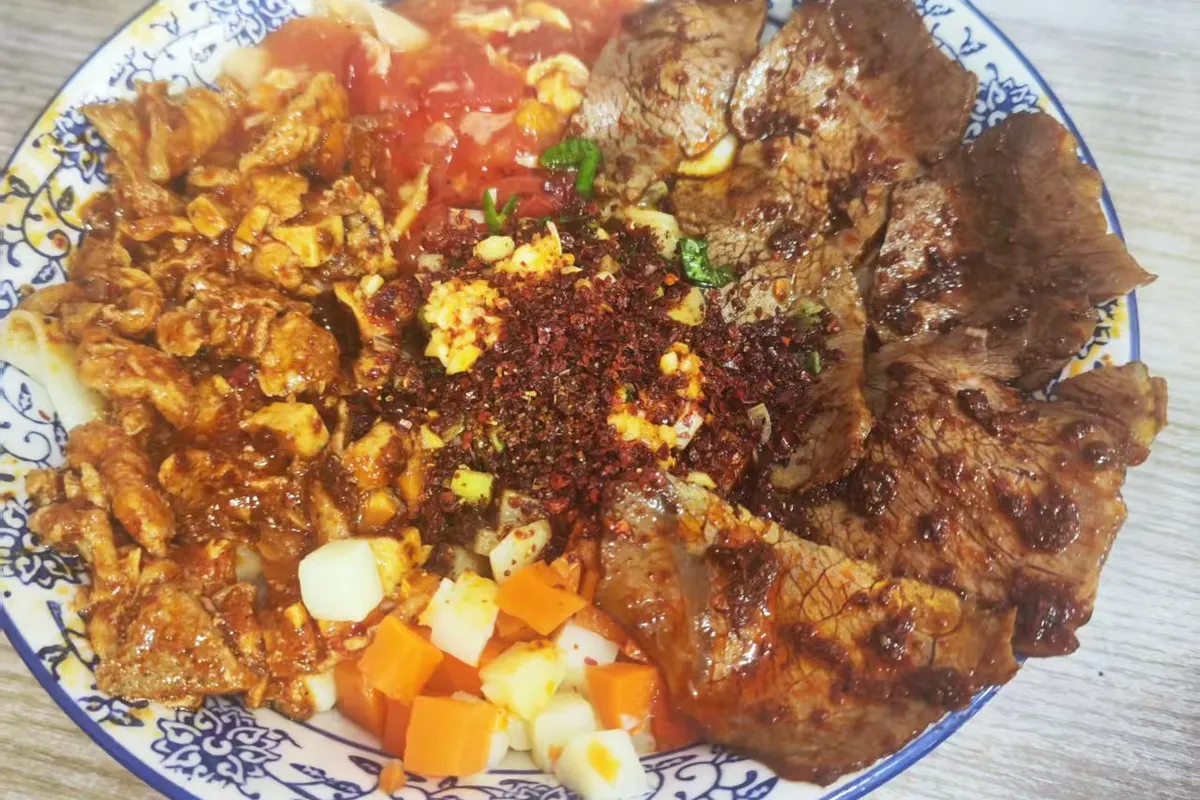
Biangbiang noodles (biangbiang面 biáng biáng miàn) are the widest thing you can order in a Shaanxi noodle shop: hand-pulled belts of dough as wide as a trouser waistband, torn long, boiled, and finished under chili flakes, scallion, and a splash of smoking oil. The name is onomatopoeia — the biáng biáng is the sound of dough slapping the counter as it’s pulled. At the shops on this page, a meal runs ¥21–42 a head.
The character itself is the joke: written properly, biáng packs around fifty strokes, appears in no standard font, and can’t be typed on any phone. Menus, apps, and signs all spell it out in letters instead — which is why you’ll see “biangbiang面” on the wall rather than the character.
One noodle is the bowl
A portion is two or three belts, each as long as your forearm. They’re thick enough to stay chewy in hot broth-less sauce, which is the point: Shaanxi wheat noodles are about bite, not soup. Locals call the shape 裤带面 (kù dài miàn) — trouser-belt noodles — and the name fits.
The oil splash, again
Most biangbiang in Shanghai is finished the same way as oil-splashed noodles — chili and scallion drowned in smoking oil, tossed at the table. The two dishes are the same idea at different widths: youpomian runs on round or ribbon noodles, biangbiang runs on the belt. If you’ve read that page, the combination-bowl shorthand there (三合一 = three toppings) works here too.
How to order
Show biangbiang面. The words that decide the bowl:
- 油泼 (yóu pō) — oil-splashed, the minimalist version
- 三合一 (sān hé yī) — three toppings over the belts, usually tomato-and-egg plus two more
- 四合一 (sì hé yī) — four toppings — the version regulars recommend at this page’s pick
Most biangbiang counters also make a roujiamo (肉夹馍), the Shaanxi pork flatbread, which is the natural side. The belts are cut to manageable length in the kitchen — you’ll still be doing some lifting.
Where to eat it
Yushanfang 御陕坊(交大店) is the heavyweight of the September 2026 rankings: 4.6 stars from more than 4,400 reviews at around ¥42 a head, on the platform’s 2026 Must-Eat list, and listed for fifteen years — a track record almost no noodle counter can match. Sixty-plus reviewers single out the four-in-one biangbiang (四合一biangbiang面). It is a full Shaanxi restaurant (陕菜) rather than a noodle counter, so a group can add cold-skin noodles (凉皮) and cured-pork flatbread to the table. The branch name places it by Shanghai Jiao Tong University’s Minhang campus in the city’s far south — out of the way, which is why it survives on locals rather than tourists. No address on file here; show the Chinese name above to a driver or a maps app.
Elsewhere in the city
Three more from the same September 2026 rankings, spread across town — pick whichever is nearest you:
- Lao Shanxi Handmade Noodles 老陕西手工面(凯旋南路店) — 137 Kaixuan South Road, Xuhui, next to Longcao Road station (Lines 3 and 12). 4.4 stars from 350-plus reviews at around ¥21, first in its area’s noodle ranking, and biangbiang is one of its two most-recommended dishes — the same shop this site picks for oil-splashed noodles. Open daily 10 a.m.–9 p.m.
- Qinyanhui 秦醃会·陕西biangbiang面(东郊店) — 383-21 Zizhu Road in the Dongjiao Center, by Jinqiao Road and Longdong Avenue, Pudong (our shop database also lists it under the spelling 秦䩊会). 4.4 stars from 1,750-plus reviews at around ¥41, first in its area’s noodle ranking. A big chain — Shanghai has dozens of branches — and reviewers mention the free sweet red-date water that comes with the bowl.
- Laowanhui 老碗会·陕西手工面(上海闵行世界商城店) — Xinzhuang, Minhang. 4.4 stars from more than 7,500 reviews at around ¥39, first on the platform’s returning-guest ranking for northwest folk cuisine in Minhang. This chain runs over twenty Shanghai branches, so even if the Xinzhuang branch is out of your way, there is probably one near you.
These four sit in four different corners of the city — south Minhang, Xuhui, Pudong, and Xinzhuang — so treat this list as “pick your district first”, not as an itinerary.